Friday, August 15, 2014

Ordinary 19 A -- August 10, 2014

WHAT’S SO FUNNY ABOUT PEACE, LOVE, AND RECONCILIATION?


Guest Preacher:  Alan Olson

Philippians 2: 1-11        

If then there is any encouragement in Christ, any consolation from love, any sharing in the Spirit, any compassion and sympathy, make my joy complete: be of the same mind, having the same love, being in full accord and of one mind. Do nothing from selfish ambition or conceit, but in humility regard others as better than yourselves. Let each of you look not to your own interests, but to the interests of others. Let the same mind be in you that was in Christ Jesus,
who, though he was in the form of God,
   did not regard equality with God
   as something to be exploited,
but emptied himself,
   taking the form of a slave,
   being born in human likeness.
And being found in human form,
   he humbled himself
   and became obedient to the point of death—
   even death on a cross.
Therefore God also highly exalted him
   and gave him the name
   that is above every name,
so that at the name of Jesus
   every knee should bend,
   in heaven and on earth and under the earth,
and every tongue should confess
   that Jesus Christ is Lord,
   to the glory of God the Father.

         Good morning! Thank you for having me to share this time of worship with you today. I was going to start with a really old joke: I just flew in from Africa, and boy, are my arms tired—and my legs, and my back, etc. etc. But I’ve been for about two weeks, so I think the statute of limitations on using that joke has expired. Mind you, I’m not joking about flying in from Africa. I have recently returned from a two-week mission trip to South Africa and the Kingdom of Lesotho.
         Now I’m going to guess that all of you are familiar with the nation of South Africa—especially if you were alive during the 1970s and 80s and were paying attention to the struggle to end Apartheid, the legal segregation of and discrimination against black South Africans and other people of color. Chances are good that most of you are familiar with South African leaders such as Nelson Mandela and Archbishop Desmond Tutu. But I would guess that there are some of you who aren’t familiar with the Kingdom of Lesotho. Let me confess that I didn’t know very much about it, either, until about two weeks ago.
         Lesotho is an independent nation of about two million people and it is entirely surrounded by South Africa. Lesotho is about the size of Maryland; it’s a very mountainous country and it looks a lot like Arizona, but with green grass and trees. It is a very pretty place, but it’s not a place that gets many visitors from the United States. In fact, I don’t think I’ve ever heard about Lesotho in the news. It’s a poor nation, but it’s far from the poorest. Although HIV/AIDS is a problem in Lesotho—as in all of southern Africa—I’m unaware of any famines or wars in Lesotho in recent memory.
         The main reason that our team went to Lesotho was to work on a service project. We were in a little town in the countryside called Morija and we were there to help build a latrine at a nursery school. This is a very typical understanding of Christian mission—a group of us went somewhere far away, to do something for someone who really needed our help. It could be viewed, as the Apostle Paul described in this morning’s reading from Philippians, as an act of “compassion and sympathy.” But most of the work on the project was done by four experienced masons; all of them were from Lesotho. At best, we were their helpers, but they could have done all of the work without us.
         Another common understanding of mission work is to send a person or a group of people abroad to spread the Good News of Jesus Christ. But that wasn’t our job, either. In fact, the town of Morija was founded by French missionaries in 1833! We missed that party by almost 200 years! Today, 90% of the population is Christian. So what were we doing there? Why did we travel some 9,000 miles to assist some brick layers? Before I address those questions, I think we need to take a closer look at Paul’s letter to the Philippians; it sheds a lot of light on Christian mission.
         Philippi was a fairly large settlement in Macedonia. It was a Roman colony. That meant that land in Philippi had been given to Roman soldiers after they had completed their service in the legions. Think about that for a second. Many of the Philippians were veterans. I imagine most of you know a few people who served in the armed forces of the United States; perhaps some of you are veterans. I’ve never met a veteran who was not proud of his or her service.
         This must have been true in Philippi, too. Imagine that you were a Roman soldier in the middle of the First Century. Perhaps you were a Roman citizen, but you had little property or chance of advancement. Or maybe you were a freeman, but not a full citizen of the Empire. Service in the legions was your chance for moving up in the world. The term of service in the Roman legions was typically twenty-five years. So, after all those years of marching around the Roman world, sleeping on the ground, in the cold, eating bad food, and fighting the enemies of the Empire—where you might have been outnumbered five-to-one, or six-to-one, or ten-to-one—if you made it through all that, then you got a plot of farm land and you earned the right to be called a Roman citizen. You made it! Now, you were someone. And you earned it! How could you not be proud?
         Instead, Paul urges the congregation at Philippi to be humble, to imitate Christ’s humility. That must have been really hard to do. Paul urges the Philippians to do “nothing from selfish ambition or conceit, but in humility regard others as better than yourselves.” But being a Roman citizen meant that you were better than most other people. So it must have been a tough pill for the Philippians to swallow, when Paul told them to set aside their pride and imitate Christ’s humility.
         This is also how we, as American Christians, must act when we engage in Christian missions. Generosity is a good thing, but when we give to others, we have to do it in humility. If we are not humble when we give, then the giving becomes about us. We must, as Paul says, “be sharing in the Spirit.” Compassion and sympathy are not acts of good will that start with us. No, this is the reconciling action of the Holy Spirit. We do not do good works of our own accord. Rather, when we act in accordance with the Holy Spirit, good works are accomplished through our actions. Or maybe I should say God’s work is accomplished through our actions. This is a fine line to walk.
         Our mission team in South Africa included sixteen people: two seminary professors, thirteen seminary students and recent graduates, and the husband of one of the students. It was a diverse group: half of us were white, half were African-American; the youngest member of our group was 23, while the oldest members were in their early- or mid-sixties. When we got to Morija, we were joined by another eight volunteers. The new volunteers were college-age students from Lesotho, who were also there to help build the latrine. As I mentioned before, there were four skilled workers already working on the job site.
         When we arrived, the hole for the latrine had been completed. The next part of the project was to lay the concrete block that would serve as the septic tank for the latrine and support the upper walls of the structure. Only two people in our group knew how to lay block. What’s more, the pit for the latrine could only accommodate four or five workers at a time. In short, we had a lot more workers than work. At first, this was really frustrating. I wasn’t the only person to ask, “What am I doing here?”
         Later that night, we had devotions with the whole group. I was paired with one of my African colleagues, a young man named Sechaba. He asked that same question. He said that many of his friends had asked him why he was doing this service project and he didn’t have a good answer. The truth is, Sechaba and I were both asking the wrong question. It wasn’t about what I was doing or what Sechaba was doing. The right question is, “what is God doing here?”
         Of course it took a long day, with too little work, for either of us to realize that something more profound was going on. In fact, the lack of work created a wonderful space for conversations to take place. The team from Lesotho got to know each other better. The team from Pittsburgh got to know one another better. And best of all, members of each team began to talk with members of the other team. God had created a sacred space in which we were all invited to be in relationship with one another. The work wasn’t just about laying block for a latrine; it was about laying the foundation for relationships across the continents. My friends, that is part of the reconciling work of the Holy Spirit.
         I have traveled overseas for a number of mission trips. One of the things that I have discovered is that most people outside of the United States have never heard of Pittsburgh. Can you believe that? Never heard of Pittsburgh? It’s strange but true. But then, a great many of us had never heard of Lesotho, a nation that is not well known outside of southern Africa. To the uninitiated, Pittsburgh and Lesotho might seem like global backwaters, names on a map that few people ever visit. Then again, two thousand years ago, Palestine was a little province on the edges of the Roman Empire. Nobody expected that a humble servant born in Palestine some two thousand years ago would eventually change the world. Amazing things can happen outside of capital cities and the centers of culture.
         We spent about a week in Morija. And yes, lots of block was laid. We didn’t finish the latrine, but we came really close. More than that, the people of the two mission teams—the team from Pittsburgh Theological Seminary and the team of young people from Lesotho—grew close to one another. We used the time to get to know one another. At this point, you might be wondering what this has to do with humility and the imitation of Christ.
         That first morning in Morija, when there wasn’t enough work to keep all of us busy, I found that really frustrating. I felt that my time wasn’t being used wisely. I wanted to be doing something. I wanted to be useful. I. I. I! In those moments of frustration, it was all about me and what I wanted. It was only after I let go of my own expectations—after I humbled myself—that I was able to move into the sacred space that God had provided for me. It was only after I let go of my ego and my attachment to the idea that I was doing something for someone else—let me repeat that: my attachment to the idea that I was doing—it was only after I let that go that I could fall in with the work of the Holy Spirit. I suspect that this was true for most of our group.
         After we let go of our expectations, wonderful things began to happen in our groups. Many of the older women in our group adopted the young people from the Lesotho team. One of the young seminarians in our group felt compelled to give his Pirates’ hat to one of the young men from Lesotho. Many of us became Facebook friends with the young people from Lesotho. We began relationships. Before we met, the groups from Pittsburgh and Lesotho were separated by distance and culture. Through our time together, doing the work of the Holy Spirit and building relationships with one another, we began to be reconciled to one another.
         One of the more interesting relationships that began there in Morija was with an older woman named Ma’Pabello. Ma’Pabello was the administrator of the nursery school where we were working. She is a wonderful witness to a life of faith in the service of others. Caring for the young children of Morija is her mission. As we got to know Ma’Pabello better, one of the women in our group asked what we could do to help her out.
         Ma’Pabello’s first answer was to ask us to pray for the children, and then to pray for the school. Talk about humility! We asked Ma’Pabello what we could do for her and she deflected the request—the children were more important!
         The women from Pittsburgh were undeterred. They wanted to know if there was anything else that we could do for Ma’Pabello, perhaps donations of money or equipment for the school. Ma’Pabello gave the most amazing reply: “Ma’Paballo: I want your songs, not your stuff!” She didn’t want a flat-screen, high-def TV for herself or a library full of books for the school. She didn’t want computers or a new car. She wanted to know our hymns of praise. She wanted to know what we sang when we humbled ourselves before God! She wanted to share in our witness to God’s love in the world!
         As I said before, the real question, the question we couldn’t ask until we let go of our pride and arrogance and made ourselves humble, was this: “What is God doing here in Morija?” For that week, God brought us together as equals, to learn from one another and to be in community with one another. God brought us there to hear Ma’Pabello’s wisdom, and then God brought us home safely so that we could share what we learned in Lesotho.
         My friends, you don’t have to go to Africa to practice humility or to do mission work. Christian mission is not just a committee! It is what each of us does every day, when we fall in with the Holy Spirit. You don’t have to go halfway around the world to do it. The work of reconciliation must be done everywhere: in Africa, yes, and also right here on Chess Street and on Main Street; here in Mon City, down in Donora, and Monessen, too! To do this, we must approach God in prayer and humility and ask God to use us in the work of reconciliation. Thanks be to God. Amen!


Sunday, August 3, 2014

Ordinary 18A -- August 3, 2014

We Are The Miracle We’ve Been Waiting For


Matthew 14:13-21
13 Now when Jesus heard this, he withdrew from there in a boat to a deserted place by himself. But when the crowds heard it, they followed him on foot from the towns. 14 When he went ashore, he saw a great crowd; and he had compassion for them and cured their sick. 15 When it was evening, the disciples came to him and said, "This is a deserted place, and the hour is now late; send the crowds away so that they may go into the villages and buy food for themselves." 16 Jesus said to them, "They need not go away; you give them something to eat." 17 They replied, "We have nothing here but five loaves and two fish." 18 And he said, "Bring them here to me." 19 Then he ordered the crowds to sit down on the grass. Taking the five loaves and the two fish, he looked up to heaven, and blessed and broke the loaves, and gave them to the disciples, and the disciples gave them to the crowds. 20 And all ate and were filled; and they took up what was left over of the broken pieces, twelve baskets full. 21 And those who ate were about five thousand men, besides women and children.


Many of you have adult children, so maybe you have already had this moment.  The moment in which you realized that the only thing holding your 20-something kid back from being a fully-fledged adult was your reflexive parental urge to jump in and do for them what they could do for themselves.  This has been my biggest stumbling block as a parent, and I revisited it this week while in Boston with Rachel.  We made a frantic pre-vacation trip there on Sunday evening, driving up her stuff that couldn’t be transported by plane.  On Monday, we unloaded the boxes from my trunk, deposited them in her new apartment, and then set off for IKEA for some cheap graduate student furniture.

It took hours, but by late afternoon on Monday, we sat on the floor of her apartment surrounded by a mountain of IKEA boxes filled with pieces of plywood, nails and  -- as anyone who has built IKEA furniture knows – instructions that may make perfect sense if you’re building cheap furniture in Sweden, but are almost incomprehensible in America.  And I knew I had a choice – I could offer to stay up all night and build the furniture for her.  Or, I could go have a nice dinner, get some sleep, and leave it for her to put together on Tuesday while I flew back to Pittsburgh for a meeting. 

Despite the fact that I was exhausted after a 10 hour drive and a long day of moving heavy boxes, every impulse in my feeble mom-brain wanted to put that furniture together for her.  My good judgment was almost overwhelmed by visions of collapsing chairs, lamps short circuiting, and a possible trip to the emergency room.  But I resisted.   I said,  “Rachel, you do it.” I think she thought I was kidding.  But I said, no I mean it.  You do it.  You’re an adult.  It’s your furniture.  You do it.

And she did.  She didn’t like it.  Like her mother, Rachel doesn’t enjoy using tools or reading directions, but she got it done.  And she did an awesome job.  My only contribution was to bring a power screwdriver in my briefcase when I flew back to Boston so we could tighten up some troublesome screws on a table. 

And I wonder how often God has to hold back from just putting all the pieces together for us when we struggling to get our lives together.  We pray for God’s help, but I think what we’re really often asking is for God to just step in and solve our problems for us in a miraculous way – preferably one that doesn’t involve too much change or challenge or effort on our part.  We secretly want to drop our problems into God’s lap and let God figure it out.  But it hardly ever works that way, does it?  It’s so annoying. God is just like, “Uh, uh. You do it.  You’ve got everything you need.  You do it.”  And it must frustrate God beyond belief to watch the people God loves so much get so many things so very wrong.  But God, like a good parent, doesn’t often step in to save us from ourselves. 

Maybe the best way to enter this familiar story of the loaves and fishes is to remember how Jesus is entering into it.  Jesus had just received about the worst news anyone could receive.  His cousin John was dead, after being beheaded in prison by Herod.  We can imagine what Jesus must have felt after receiving that news.  Shock.  Grief.  John’s violent death may have also made clear to Jesus that the work he is doing will likely lead to the very same fate for him.  It’s only a matter of time.  So Jesus withdraws to a quiet place to be alone and deal with the sorrow, anger, and fear of what’s next in this difficult ministry.

But the quiet time alone doesn’t last very long.  People get wind of where Jesus has hidden himself.   They need what people always need from Jesus -- healing.  And Jesus is able to shake off his sorrow and his anger and his worry long enough to take care of the people out of his compassion and love. 

He begins to heal and it takes a long time, all day really.  It’s a huge crowd and the people have a lot of problems and before you know it, it’s evening.   As the sun goes down, the crowd is still hanging around, and has grown from hundreds of people into thousands.  Jesus is entirely preoccupied and hasn’t noticed the time, but the disciples soon see a big problem looming.  They are in the middle of nowhere and all of these needy people are going to be very, very hungry, very, very soon.  Time to shut this thing down and send these people back to wherever they came from before they become a angry mob demanding food.  Jesus may have the energy to keep going all night, but the disciples barely have enough food to feed themselves, let alone the thousands of people who keep streaming in to the shoreline. 

When the disciples tell Jesus that it’s time to send the people home for supper, Jesus says:  “Ok.  No problem. You do it.  Give them something to eat.”  The disciples look at the five loaves of bread and two fish, and then they look at Jesus.  Jesus must be kidding, right?  There’s not enough food here for us, Jesus.  What are we supposed to do?

I can imagine Jesus sighing deeply when he hears the disciples say, “There’s not enough.”  I can imagine Jesus saying, “Give me that basket, already,” as he sighs again, lifts his eyes to heaven, thanks God for the fish and bread, and then says to the disciples, “You do it.  Go give those people something to eat!” 

The disciples look at the bread and fishes and see a disaster brewing. 
Jesus looks at the bread and fishes and sees a dinner party for thousands. 
Which view is reality?  Is this really a story about a miracle that only Jesus can perform?  Or, maybe, this a story about what happens when we are finally somehow able to see the world the way Jesus sees it?

The Kingdom of God is like this:  Abundant. There is enough, more than enough.  Enough for everyone.

The kingdom of the anxious disciples is like this:  Scarcity.  We don’t have enough for ourselves, so how can we feed anyone else?  Better to hold on to what we have.

There’s a stark difference between the world that we see, and the Kingdom of God.  When we drop our scarcity blinders, if only for a moment, and look a little more closely at what we are holding in our hands, maybe we can see how abundantly God has already blessed us.  Maybe we could see the world the way Jesus sees it. 

I thought about this text on Tuesday night when the community gathered to hear about Holy Family Institute’s plans to care for up to 3-dozen children who have arrived in America from Central America without family or parents accompanying them.  One of the arguments made in opposition to Holy Family’s plans was that money spent to care for children from Central America would result in not enough money left to care for American children.  People spoke as if compassion for children is a zero sum game and there’s only so much of it to go around.  I think Sister Linda Yankoski said it best when she answered the question about why they were welcoming the Central American children when she said this:  “There’s a child sleeping on a floor in Texas.  I have an empty bed.”  Taking care of 36 children from Central America will not result in less care for the more than 11,000 American children and families that Holy Family Institute serves each year.   Holy Family simply believes that they can do more. They believe their compassion can extend even further, because they follow Jesus of deep compassion, and they trust in a God of astonishing abundance. 


This scarcity mindset extends, unfortunately, even into churches.  I recently heard about a church that decided to reach out to their neighborhood by holding a summer festival on their lawn, including food booths run by the deacons to raise money for local mission.  One of the deacons suggested giving free tickets for the food booths to the local food pantry to distribute to clients so that they could come to the festival free of charge.  One of the deacons said, “We can’t possibly do that.  How could we figure out how much food to buy?  What if we don’t have enough food for the people who are paying?”  Another objected saying, “We can’t give out free food!  We’re raising money for mission!”  It may not surprise you to hear that most of the people who attended the festival were church members, which is probably what most of church people wanted anyway.  They really weren’t interested in getting to know their community. 

See, that’s the real danger of scarcity thinking -- it lets us off the hook and excuses us from doing those things that make us uncomfortable or are just plain hard to do.  Unglamorous.  Scary even.  If we say we don’t have enough, then we don’t have to do anything and we can send people away.  And yet, this is exactly the opposite of what Jesus would have us do.  In fact, you could almost say that Jesus is daring us to act.  People are hungry?  You feed them.  People are in pain and suffering?  You take care of them.  The world is falling apart?  You get involved to make it better.  With whatever you have, even if it looks like very little or even nothing.  Help in whatever way you can help, even if you feel completely helpless. 

This story isn’t about an inexplicable miracle of magically expanding loaves finding their way into empty bellies or amazingly multiplying fishes jumping out of baskets into hungry mouths, all thanks to a little Jesus hocus pocus.  It’s a story about the people of God trusting that the deepest needs of this world can be met by God’s people in the world right now. That’s not a miracle.  That is gospel truth, as plain as the nose on your face.  We are the miracle.  We are the miracle.  We are the miracle we’ve been waiting for.  Right here.  The miracle is sitting right here in this church.  And the miracle is sitting in the church up the road and across the county and across the ocean and around the world.   2 billion Christians.  You want to tell me we can’t get something done with 2 billion Christians, even if each of us has just a couple loaves and a couple fish?  And if we invited the Jews and the Muslims and the Hindus and the Buddhists and even non-believers of good will to come along side of us, we might just get something done. 

I’ve come to the conclusion that it is not that our problems as a church, or a country, or even as a world have so big, but that our expectations and aspirations have become so small.  Part of that is understandable in most parts of the world where merely scratching out a daily existence is a minor miracle.  But most of us walk around thinking we only have a couple of loaves of bread and a few tiny fish when, in fact, we have many more resources than we imagine.

For the next six weeks, beginning this Sunday, we will be engaging in conversation with each other about the future of our church and the possibilities that exist for vital ministry here in this community.  You’ll be talking about what we already do well as a community of faith – what excites us about ministry here.  What challenges us?  What do we need to learn about the community around us?  How are their needs?  How deeply do we understand the way in which people will engage in church into the 21st century? What has God already given us to do the ministry that needs to be done here and now, not 20 or 30 years ago?  What is Jesus already up to?  Where is Jesus already at work and how can we get in on that kingdom building action?  After those conversations, there will be more conversations, more dreaming, more praying, more asking of questions and looking for answers as we talk about adapting to a new reality. What we will become is entirely up for grabs.  But I promise you, we will be changed.   And God has already given us everything we need.

The disciples could have hidden the small amount of food they had.  They could have kept it in their satchels and made sure that they would have something for themselves at the end of the day.  But they didn’t.  They took what little they had and gave everything to Jesus.  He blessed it, and blessed them, and then he told them to go get busy.  Feed my people.  There’s enough for everyone. 

So here’s what we’ll do.  Take what little you have and hold it in your hands.  That small holy gift you’ve been holding back for such a time as this although you didn’t know it.  Now that you’re looking at it more closely, you are almost embarrassed.  It doesn’t like very much, does it?  Hardly worth mentioning, really.  But hold it out anyway.  Trust him.  Wait for him.  And you will hear his voice that says, “Oh yes.  This.  This.  This is what I’ve been waiting for you to discover while you’ve been fussing about your fears and your failures and all those things you though mattered so much to me.  This.  This.  This, I can work with.” 

Thanks be to God.  Amen.


Sunday, July 20, 2014

Ordinary 16A -- July 20, 2014


Learning to Love The Weeds.  

Or At Least Learning to Live With Them.


We opened our time together with members of the congregation telling us the parables they saw around them over the past week.  We heard at least a half dozen stories that supported the notion that we are living in a "Parable Universe" and can see glimpses of the Kingdom of Heaven.

(Much of this sermon was improvised, but this is the basic outline). 

Matthew 13:24-30, 36 - 43

He put before them another parable: “The kingdom of heaven may be compared to someone who sowed good seed in his field; 25but while everybody was asleep, an enemy came and sowed weeds among the wheat, and then went away. 26So when the plants came up and bore grain, then the weeds appeared as well. 27And the slaves of the householder came and said to him, ‘Master, did you not sow good seed in your field? Where, then, did these weeds come from?’ 28He answered, ‘An enemy has done this.’ The slaves said to him, ‘Then do you want us to go and gather them?’ 29But he replied, ‘No; for in gathering the weeds you would uproot the wheat along with them. 30Let both of them grow together until the harvest; and at harvest time I will tell the reapers, Collect the weeds first and bind them in bundles to be burned, but gather the wheat into my barn.’”

36Then he left the crowds and went into the house. And his disciples approached him, saying, “Explain to us the parable of the weeds of the field.” 37He answered, “The one who sows the good seed is the Son of Man; 38the field is the world, and the good seed are the children of the kingdom; the weeds are the children of the evil one, 39and the enemy who sowed them is the devil; the harvest is the end of the age, and the reapers are angels. 40Just as the weeds are collected and burned up with fire, so will it be at the end of the age. 41The Son of Man will send his angels, and they will collect out of his kingdom all causes of sin and all evildoers, 42and they will throw them into the furnace of fire, where there will be weeping and gnashing of teeth. 43Then the righteous will shine like the sun in the kingdom of their Father. Let anyone with ears listen!


You know what a weed is, right?  A weed is a plant that you don’t like.  Because the "bad weed" crowds out the plants you do like.  So we have to admit right off the bat that weeds are not inherently bad, just bothersome. 

The biblical scholar Karoline Lewis has said that the parable of the wheat and the weeds is not told for the sake of action – to send us out to weedy fields and begin pulling at noxious plants for all we’re worth.  No, this parable is told by Jesus for the sake of honesty about the different kinds of plants that keep springing up in the Kingdom of Heaven.  Specifically, we are told by Jesus to leave the weeds alone because we might just hurt the wheat while we’re poking around.  Not because it’s a good thing to let the weeds grow.  But because we are human beings and honestly, we can’t tell the difference between what is a weed and what isn’t.  As in many things in life, what looks like evil and what looks like goodness seems to determined by where you’re standing and what kind of plants you’re trying to grow.  And the sower in this story doesn’t seem very much interested at all in a pure crop.  We have a sower who seems willing to risk a few big weeds for the sake of some big wheat.

We just can’t resist trying to be good servants so we have a hard time putting down our rotary tillers.  We love battling the weeds.   Christians have a long history of trying to figure out where the weeds are and what to do about them.  We poison our gatherings with finger-pointing at people we think do not measure up, despite Jesus’ warning in this parable that we risk losing lots of good wheat in the process.  Nobody expects the church to be a perfect weed-free field, but a lot of people avoid the church because they simply can’t stand the smell of Round Up.  The poisonous atmosphere sometimes generated by our weed-wacking ways is wilting the faith of too many people, especially young people who are just beginning to grow.  I suspect that is at least part of the reason the church is having a lot of trouble feeding itself.  We’ve become so focused on pulling out the weeds that we’re well on our way to killing the field altogether.

Can you tell who is a weed and who is wheat?  Is our calling as disciples to seek out and purge sin and evil? That doesn’t seem to be the point of the parable Jesus is telling us here.  If you think you know the difference between people worth saving and people who can never be redeemed, I think you’re on some very shaky ground with this parable.  And, frankly, I don’t want that job.  I don’t trust myself.   Because weeds and wheat look an awful lot a like, at least in the early stages of growth.  It’s only later on that you can tell something may have gone wrong and even then – you can’t pull the weeks without harming the wheat.  I don’t trust myself for a moment to be able to make that judgment. 

The possibility exists, my dear ones, that weed doesn’t just grow outside us.  The weed may indeed be inside us.  Growing right along side the wheat, in fact, completely intertwined so much so that cutting out the weed seems a completely impossible task.  How do you even begin?

So I’m not sure I trust you to figure out who or what is good and who or what is evil, and I sure do not I do trust myself to make that call.  But I do trust God.   And it could be this parable is telling us that our work in the world as Christians is not to figure out who is good and who is evil – or even wonder why God allows weeds at all -- but to spend all our energy in being the good in the world.  To live the Gospel. To be the light. To be the salt.  This should be good news. This parable calls us simply to be. To be the good in the world with the full awareness of that there is also evil inside us and all around us. To be light when darkness will surely try to snuff us out. To be salt when blandness is always the easier and safer path.

That is why this parable is such a gift to us.  It forces us to look at the weediness of our own souls.  And most of us have enough personal garden work to last us a lifetime.  So let me ask you this:

1.  What are the biggest weeds in you life?  What weeds threaten the good wheat you want to produce in your life’s field?  Stress?  Illness?  Money issues?  Fear?  Anger?  What chokes off the good that you want to be and do? (5 minutes)  

My big weed is impatience.  I have always fought the impulse to believe it’s just easier and quicker to do things myself than rely on someone else who will probably move less quickly than I want to move or not do something the way that I think it should be done.  I’m much better than I was 20 years ago, thanks to having children around.  By their very nature, children – especially small children – slow you down.  They change your plans and thrown you off course.  I have discovered that it’s not such a tragedy if a project takes longer than I think it should.  I have discovered that dawdling can be a useful thing if it builds a better relationship between me and other people. 

2.  What are the weeds in your life teaching you that you cannot learn any other way?  In other words, why do you think God is telling us not to pull the weeds, but to leave them there until harvest?   Can something good come from weeds? (Assignment for next week!)

The hardest part of this parable for me is that sower must wait, living with both the wheat and the weeds until the day of harvest when they may be separated in due time.   In the meantime, it is hard to know what is the right thing to do sometimes.  We face a multitude of other difficult choices:
 like between getting a job to support the family or staying at home to spend more time with the family;
or between supporting someone who consistently struggles at work and pulls the quality of your team down or firing that person;
or between choosing the best school you’ve been accepted to or one that is more affordable;
or between two different treatment options in responding to a grave illness;
 
or between giving into peer pressure because it just plain sucks to be left out or choosing to stick to your values and risk isolation.


Dear Lord, our lives are colored by ambiguity and we don’t always know the right or best thing to do. But we do know that your love is guiding us and that you have called us to live as your people in the world. When we face hard choices, give us eyes to see the best path forward and the courage to follow it. When we make mistakes, forgive us. When we are hurt by our choices, comfort us. When we hurt others, help us to reach out to them in love. And above and beyond all these decisions, remind us that you still love us and call us back to this place that we may be forgiven, renewed, called, and sent forth once more as your beloved children. In Jesus’ name we pray. Amen.


Monday, July 14, 2014

Midsummer Update -- What's Happening at Emsworth U.P.?

Flip Flop Summer is Underway!


Throughout July and August, our Sunday worship begins at 10 a.m. in the fellowship hall.  Each Sunday we will share the Lord's Supper, engage in conversation around the scripture texts, and discover new music and new ways to worship God in a casual, relaxed atmosphere.  Want to wear your flip flops and shorts?  Yes, let's!


Learning To Walk in the Dark -- a conversation with Barbara Brown Taylor's new book.

Pastor Susan continues to lead a summer book discussion around Barbara Brown Taylor’s New York Times bestseller, Learning to Walk in the Dark, on Wednesday evenings from  6:30 p.m. to 8:00 p.m.  The book is available now for purchase from Amazon.com or your favorite local bookseller.


New Beginnings/Unglued Church House Meetings in August and September

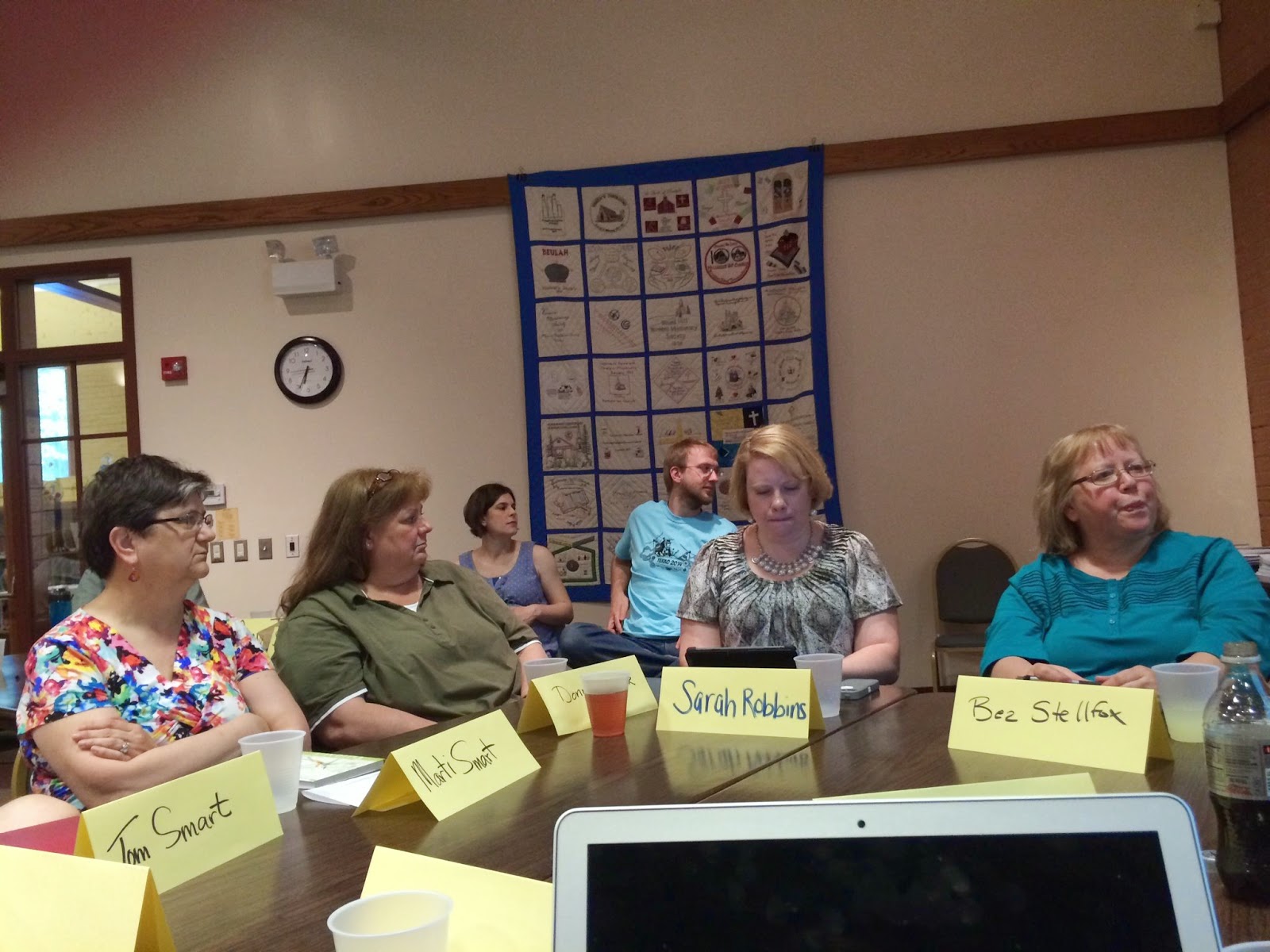
The next step in discerning the future of Emsworth U.P. is a 6 week series of "house meetings" for members and friends of the congregation to review the assessment report from New Beginnings and begin imagining the future for our church.  

You may choose to attend a meeting after Sunday worship, or on Tuesday evening.  The material to be covered either day will be identical.  

Sunday meetings will be from 11:15 AM to 1:00 PM ... led by Donna, Bez, and Marti 
1. August 3 after worship
2. August 10 
3. August 17 
4. August 24 
5 September 7 
6. September 14 

Tuesday evening meetings will be from 6:30 to 8:15 PM ... led by Tom, Jean, and Jon. 
1. August 5 (at Jon and Bez Stellfox's home -- future locations TBD)
2. August 12 
3. August 19 
4. August 26 
5 September 9 
6. September 16 


Jennett Warne 95th Birthday Celebration


After worship on Sunday, July 27, we will celebrate Jennett Warne's 95th birthday with cake/punch in the fellowship hall.  Please join us as we honor Emsworth U.P's most senior member!


Mission Giving for 2nd Quarter

Pittsburgh Presbytery (undesignated mission) -- $200
Allegheny County Jail Ministry --  $250
Pittsburgh Presbytery New Church Development -- $250
Pittsburgh Presbytery Malawi Partnership -- $300


Pastor Susan's Vacation and Guest Preachers

Pastor Susan will be on vacation from August 4 to August 23.  She will return to the pulpit on August 24.  In case of emergency, please contact Clerk of Session, Jon Stellfox.  Pastor Donna of Community Presbyterian Church will also be available in case of a pastoral emergency.    

August 10:  Alan Olson
August 17:  Keith Mehelcic


Ordinary 15A -- July 14, 2014

"A Parable Universe"


"The Sower" Fr. Nunilon Bancaso

Matthew 13:1-9, 18-23


That same day Jesus went out of the house and sat beside the sea. Such great crowds gathered around him that he got into a boat and sat there, while the whole crowd stood on the beach. And he told them many things in parables, saying: "Listen! A sower went out to sow. And as he sowed, some seeds fell on the path, and the birds came and ate them up. Other seeds fell on rocky ground, where they did not have much soil, and they sprang up quickly, since they had no depth of soil. But when the sun rose, they were scorched; and since they had no root, they withered away. Other seeds fell among thorns, and the thorns grew up and choked them. Other seeds fell on good soil and brought forth grain, some a hundredfold, some sixty, some thirty.  Let anyone with ears listen!" 


“Hear then the parable of the sower.  When anyone hears the word of the kingdom and does not understand it, the evil one comes and snatches away what is sown in the heart; this is what was sown on the path. As for what was sown on rocky ground, this is the one who hears the word and immediately receives it with joy; yet such a person has no root, but endures only for a while, and when trouble or persecution arises on account of the word, that person immediately falls away. As for what was sown among thorns, this is the one who hears the word, but the cares of the world and the lure of wealth choke the word, and it yields nothing. But as for what was sown on good soil, this is the one who hears the word and understands it, who indeed bears fruit and yields, in one case a hundredfold, in another sixty, and in another thirty."


Listen!  The kingdom of heaven is like this -- a sower went out to sow.  

And thus we begin a series of parables from the Gospel of Matthew.  Over the next three weeks, we will be considering a series of parables in the 13th chapter of Matthew. They’ll be coming at us thick and fast, which is appropriate because that’s what parables tend to do.  In fact, the literal meaning of “parable” is something that is thrown along side.  Boom – parables drop in without warning.  So parables it is for us for a couple of weeks. 

Parables are tricky business, I think, despite the fact that many of us have heard most of these parables more than once.  That could be why they are tricky.  We know them too well.  And maybe many of you think you’ve got a handle on why Jesus spoke in this parabolic way and what Jesus meant, especially when he told stories like this about farming and planting and seeds.

I am not one of those people, I fear, although that hasn’t stopped me from loving the parable of the sower. The problem, at least for me, is that I am terrible at gardening.  Although I come from a long line of earnest farmers, and spent a lot of time as a kid pulling weeds and picking vegetables, I am known in my family as Susan, The Plant Killer. I have never had much success deliberately growing anything beyond a few pots of herbs.  Except for that one late summer day I scooped up a drooping Black Eyed Susan plant at 75% off from Home Depot, stuck it in the front yard, and have watched it blossom like crazy every July for the past 10 years. But the truth is, beyond that miraculous Black Eyed Susan, I have had little or nothing to do with their blooming.  Every time I’ve touched anything in my garden, it’s been a disaster. 

So it helps me to remember that Jesus was a city boy, not a farmer.  He grew up with a father who was carpenter, yet not one of Jesus’ parables begins with: “The kingdom of heaven is like a Black and Decker sander on an rough piece of wood…”  Jesus may not have been an experienced farmer, but Jesus moved around a lot in the gospels, and everywhere he went, he was always a deep and observant listener.  Jesus might not have been a farmer, or a fisherman, or a woman baking bread or a bridesmaid getting ready for a wedding.  But he listened to all kinds of people, and used their language so they could see the strange logic of the Kingdom of God – or, as it is referred to in Matthew, the Kingdom of Heaven.  And Jesus’ intention in telling these parables is always the same, I believe.  It’s to encourage those who have ears to hear to seek the kingdom of heaven in the every day world.  It is possible – in fact it’s our job – to look for the kingdom that is always breaking open among us.   And Jesus helps us to do that.  Parable, by parable. 

Anna Carter Florence, a homiletics professor at Columbia Theological Seminary has suggested that Christians live not in a parallel universe, but a “a parable universe.” Which is to say that parables that reveal the kingdom of heaven are not only in the Bible, but also everywhere, coming along side us like asteroids. Parables are everywhere, all the time if we have ears to hear and imaginations open to the possibilities.  

Here is part of a lecture Dr. Carter-Florence gave in May about how Jesus models a “parable universe” in the gospels.[1]

(Recording of Anna Carter Florence lecture: 26:41 – 33:15)

The kingdom of heaven is like this.  A sower went out to sow.  You don’t have to know much about farming to know that seed should be planted in good soil.  That’s apparent even to a plant killer like me.  But this isn’t a story about a prudent sower who keeps track of every seed.  In fact, this sower doesn’t seem worried about where the seeds are landing at all. This is a sower who sows everywhere.  On hard, dry ground.  On rocky soil.  Among thorns.  And on good soil.  Everywhere.   Everything about this sower seems ridiculous until you remember that this isn’t a story about horticulture or crop yields, but about the kingdom of heaven.  It’s about grace. 

The Kingdom of heaven is like seed that lands on dry ground and is almost immediately eaten by birds.  Is that really the end for the seed?  The seed is still the seed.  The Word is still the Word.  Its power is not any less because it’s been taken away by – the bird, the devil?  The seed will end up somewhere, courtesy of the bird’s digestive system.   Have you ever had the experience of a plant you had nothing to do with coming up in a place you never expected?   God’s purpose will be fulfilled even when the Word lands somewhere unexpected.

The kingdom of heaven is like this:  seeds fell on rocky ground, where they sprang up quickly. But when the sun rose, they were scorched; and since they had no root, they withered away. Other seeds fell among thorns, and the thorns grew up and choked them.

The seed springs up, but the plant dies quickly.  Again, is this the end of the seed’s story?   But even in the plant’s death, new life happens.  The Word doesn’t depend on the length of the plant’s life in order to bear the fruit it needs to bear.  We like plants to last a long time.  We like our perennials to keep blooming year after year.  And sometimes they do.  But God’s purposes can be fulfilled in even the shortest season. 

And every once in a while the seed lands on good, fertile soil.  And something grows with deep roots and beautiful blossoms and a tremendous yield of fruit.  A bumper crop, more tomatoes than any of us could eat in a thousand summers.  Everyone can have some, even those with the hardest hearts.  It’s like the zucchini you drop at the neighbor’s front porch when you have run out of ways to cook it.

But you know what? Even that fruitful plant will come to the end of its life.  But like the seed that hit the ground, the seed choked by the thorns or the rocks – the Word of God does not end when the plant dies.  As it was in the beginning, it will be forever. 

This is not a story about what good soil we are.  It’s a story of what God is doing, every single day, in staggering numbers.  In the smallest seeds, hidden in the most unlikely places.  Good soil, bad soil, rocks and thorns and sand.  The Word does not fail. The worst we can do is get in its way on occasion.  But even then, all we do is delay the harvest.  Not prevent it.

So in the meantime, we pay attention.  We pay attention to this parable universe that Jesus is showing us.  Our job as disciples of Jesus is actually pretty simple, really.  To pay attention to where the seeds are falling.  To bear witness to the fruit that is flourishing.  To shout about the goodness we see.

I have to admit that I have fallen a bit in love with this idea that we live in a parable universe.  And I hate to break it to you.  Once you start really paying attention and begin looking for parables about the kingdom of heaven, you realize that they happen ALL THE TIME.  They are everywhere. 

Here’s one that happened to me just this week.

The kingdom of heaven is like this.  A awkward, shy 13 year old boy is invited to a birthday party.  For the first time in 4 years.  His mother tries to talk him out of going because she’s not sure she can take the pain of seeing her beloved boy get rejected…again…by the mean kids who will be there.  She worries about many things.  No, she is stressed out beyond belief by many things.  It’s a pool party – will he be dunked?  Will he be left out …again…forced to sit by the melting ice cream cake on the picnic table while all the other kids play Marco Polo?  She tries to talk her son out of going, even tries to bribe him with an alternative plan for the evening. 

How about a movie? 

No, thank you Mom. 

How about going out to dinner?
 
Mom, stop it. 

So he goes to the birthday party. 

Later, when the 13 year old comes home (with his dad because his mother is a big chicken) his mother is surprised.  No, she is astonished when the 13 year old happily bounces into the house.  There were only seven kids at the party.  All of them the class outcasts.  They bonded while playing Marco Polo in the pool.  They laughed over pizza and birthday cake.  There’s even a rumor afloat that the little girl who invited him to the party might have a teeny little crush on the 13 year old but he doesn’t want to talk about it, MOOOOOOOM. 

The kingdom of heaven is like this.  A little bit of kindness and heavenly hope dropping unexpectedly into the life of a 13 year old who has been waiting a long time to be invited to a party.  Now, can you tell me where the heck that seed come from? 

Next week, we’ll begin our sermon time with a space for you to testify where you’ve seen the kingdom of heaven break into your ordinary week.  We’ll share our parables beginning:
“The Kingdom of Heaven is like this.”

Let those who have ears, listen!  Thanks be to God.  Amen


[1] Anna Carter Florence, Festival of Homiletics, May 20, 2014.